



EZH1
EZH1 is a PRC2 catalytic homolog that methylates histone H3 lysine 27 and supports transcriptional repression in chromatin regulation[1]. Mechanistically, EZH1 colocalizes with H3K27me3 and preserves this mark on development-related genes when EZH2 is absent, linking EZH1 to embryonic stem cell identity and pluripotency execution[1]. In adult models, EZH1 maintains hematopoietic stem cells in a slow-cycling, undifferentiated state and protects them from senescence-like cell-cycle arrest[2]. Compared with EZH2, EZH1 forms similar PRC2 complexes but represses chromatin through a distinct mechanism, because PRC2-EZH2 strongly catalyzes H3K27me2/3 whereas PRC2-EZH1 more directly compacts chromatin[3]. Functional redundancy is context-dependent, as EZH1 and EZH2 jointly sustain H3K27 trimethylation in mouse skin, where double targeting abolishes H3K27me3 and disrupts hair follicle homeostasis and wound repair[4]. In cancer research, EZH1/2 dual inhibitors provide experimental tools to test whether simultaneous EZH1 and EZH2 blockade suppresses H3K27me3 more effectively than EZH2-selective inhibition[5]. Valemetostat studies further support EZH1/2 inhibition as a translational model in relapsed or refractory adult T-cell leukemia/lymphoma[6].
References:
- [1]. Shen X, et al. EZH1 mediates methylation on histone H3 lysine 27 and complements EZH2 in maintaining stem cell identity and executing pluripotency. Mol Cell. 2008 Nov 21;32(4):491-502. [Content Brief]
- [2]. Hidalgo I, et al. Ezh1 is required for hematopoietic stem cell maintenance and prevents senescence-like cell cycle arrest. Cell Stem Cell. 2012 Nov 2;11(5):649-62. [Content Brief]
- [3]. Margueron R, et al. Ezh1 and Ezh2 maintain repressive chromatin through different mechanisms. Mol Cell. 2008 Nov 21;32(4):503-18. [Content Brief]
- [4]. Ezhkova E, et al. EZH1 and EZH2 cogovern histone H3K27 trimethylation and are essential for hair follicle homeostasis and wound repair. Genes Dev. 2011 Mar 1;25(5):485-98. [Content Brief]
- [5]. Sato T, et al. c-Jun N-terminal kinase in pancreatic tumor stroma augments tumor development in mice. Cancer Sci. 2017 Nov;108(11):2156-2165. [Content Brief]
- [6]. Izutsu K, et al. An open-label, single-arm phase 2 trial of valemetostat for relapsed or refractory adult T-cell leukemia/lymphoma. Blood. 2023 Mar 9;141(10):1159-1168. [Content Brief]
All Product Categories
-
EZH1 Related Products (11)
Related Products (11)

- 1
-
Valemetostat
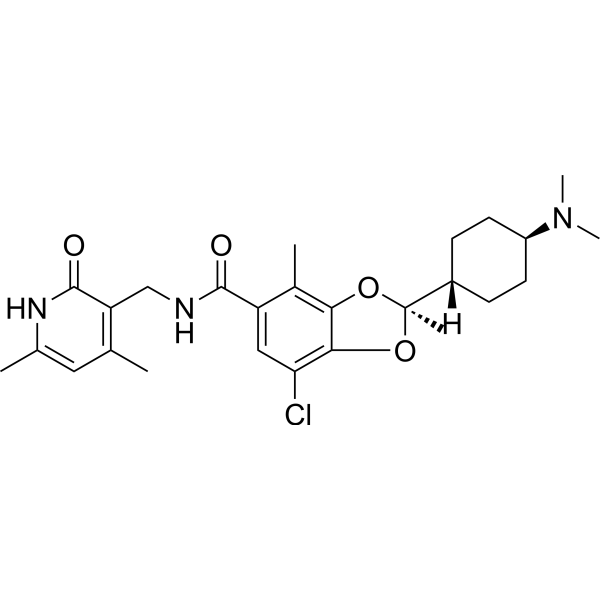 0 ImagesSynonyms: DS-3201Valemetostat (DS-3201), a first-in-class EZH1/2 dual inhibitor with IC50 values <10 nM. Valemetostat can be used for the research of relapsed/refractory peripheral T-cell lymphoma.
-
UNC1999
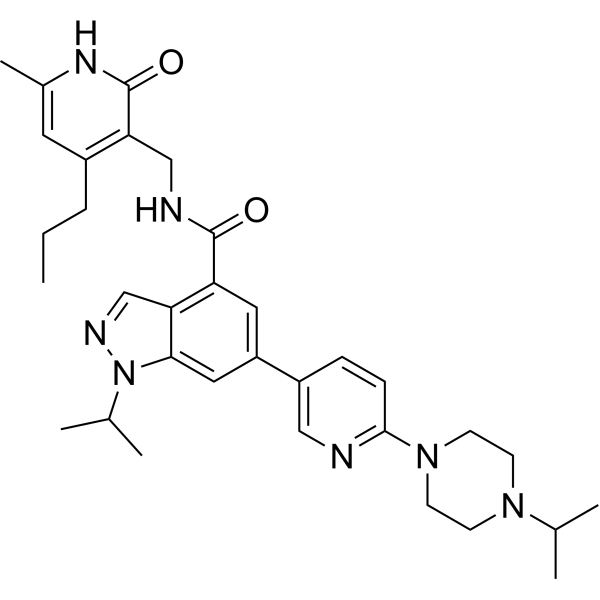 0 ImagesUNC1999, a chemical probe, is a SAM-competitive, potent and selective inhibitor of EZH2/1 with IC50s of <10 nM and 45 nM, repectively.
-
Valemetostat tosylate
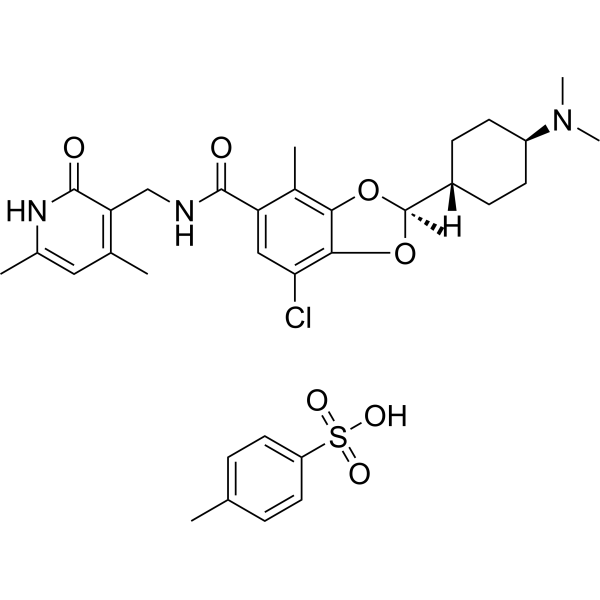 0 ImagesSynonyms: DS-3201 tosylateValemetostat (DS-3201) tosylate, a first-in-class EZH1/2 dual inhibitor with IC50 values <10 nM. Valemetostat tosylate can be used for the research of relapsed/refractory peripheral T-cell lymphoma.
-
MS4322
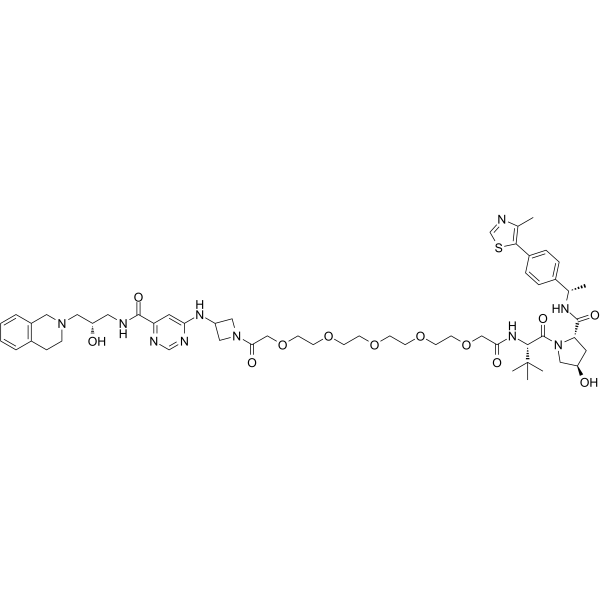 0 ImagesSynonyms: YS43-22MS4322 (YS43-22) is a specific PRMT5 PROTAC degrader. MS4322 reduces the PRMT5 protein level with a DC50 of 1.1 μM in MCF-7 cells. MS4322 inhibits the methyltransferase activity of PRMT5 with an IC50 of 18 nM. MS4322 promotes ubiquitination and degradation of PRMT5. MS4322 can be used for the research of breast cancer, lung cancer, and hepatocellular cancer. (Pink: PRMT5 ligand (HY-173092); Blue: E3 ligase ligand HY-112078); Black: linker (HY-124780); E3+linker (HY-173093 )).
-
PROTAC EZH2 Degrader-26
 0 ImagesCat. No.: HY-181327CAS No.: 2641601-66-1

-
MS4322 (isomer)
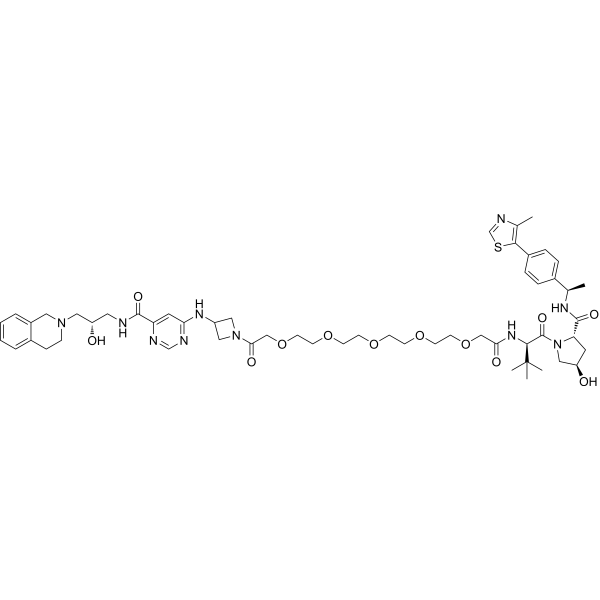 0 ImagesSynonyms: YS43-22 (isomer)MS4322 (YS43-22) isomer is an isomer of MS4322. MS4322 is a specific PRMT5 PROTAC degrader. MS4322 reduces the PRMT5 protein level with a DC50 of 1.1 μM in MCF-7 cells. MS4322 inhibits the methyltransferase activity of PRMT5 with an IC50 of 18 nM. MS4322 promotes ubiquitination and degradation of PRMT5. MS4322 can be used for the research of breast cancer, lung cancer, and hepatocellular cancer.
-
(S)-HH2853
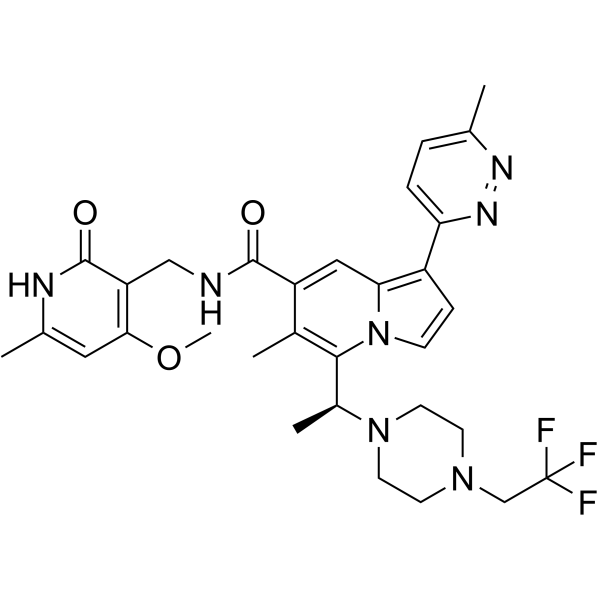 0 ImagesCat. No.: HY-144881CAS No.: 2202678-05-3(S)-HH2853 (compound 200), a PYRIDINO five membered aromatic ring compound, is a potent EZH1/2 dual inhibitor with an IC50 of <100 nM for EZH2_Y641F. (S)-HH2853 has the potential to be used in the research of anti-tumor or autoimmune diseases.
-
NSD2-IN-6
 0 ImagesCat. No.: HY-180553NSD2-IN-6 is a selective and orally active NSD2 inhibitor with IC50s of 3.8 and 274 nM for NSD2 and NSD1 respectively. NSD2-IN-6 reduces H3K36me2 levels, reverses cell plasticity by restoring the androgen receptor (AR) signaling pathway. NSD2-IN-6 reduces a shift from cluster 2 and 3 states towards the cluster 1 state in organoids. NSD2-IN-6 exerts antitumor activity by reversing tumor cell plasticity, suppressing growth, and promoting apoptosis in vivo. NSD2-IN-6 can be used for prostate cancer research.
-
HH2853
 0 ImagesCat. No.: HY-187629CAS No.: 2202678-04-2HH2853 is an orally active EZH1/EZH2 inhibitor, with an IC50 of 9.26 nM for EZH1 and IC50 values ranging from 2.21 to 3.75 nM for both wild-type and mutant EZH2. HH2853 simultaneously inhibits the methyltransferase activities of EZH1 and EZH2, blocks the compensatory pathway that arises following EZH2 inhibition, and reduces H3K27me3 levels. HH2853 upregulates the expression of c-Myc and TfR-1 to induce intracellular iron accumulation, and stabilizes GPX4 via HSPA5 to suppress ferroptosis. HH2853 combined with Erastin (HY-15763) synergistically inhibits EZH2 wild-type DLBCL cell proliferation. HH2853 alone shows weak activity against EZH2 wild-type DLBCL and is well tolerated. HH2853 is applicable for research related to diffuse large B-cell lymphoma, non-Hodgkin's lymphoma, epithelioid sarcoma, and follicular lymphoma.
- 1



